

We would like to introduce you to one of our role model companies; Katoen Natie.
Katoen Natie (KTN) are a global organization specialising in warehousing; logistics and port operations. They are currently present in twenty-eight different countries spread out across five continents employing over 12,000 people worldwide with 154 logistic platforms. The largest division of is their petrochemicals division which sees them partnering with the world’s major chemical companies by packaging and distributing plastics as a raw material. KTN is a Belgian company (the largest shareholder being Fernand Huts) and was founded in 1854 in the port of Antwerp (their headquarters are located there to this day). They opened their site in Grangemouth in 1999 where they distribute polypropylene and polyethylene worldwide (for INEOS).
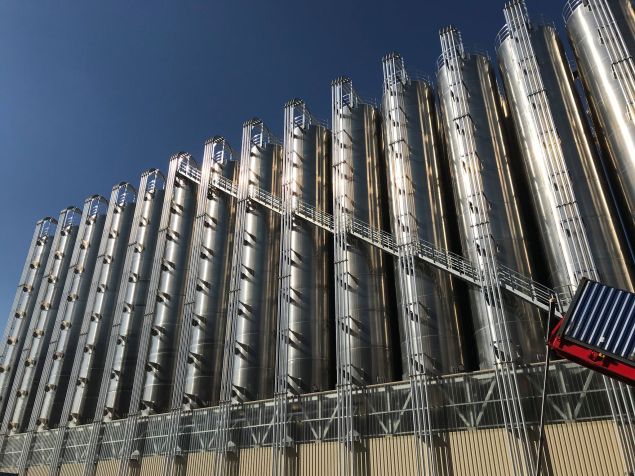
KTN told us that back in 2017 they signed up to Operation Clean-Sweep together with Ineos. The target for the Grangemouth terminal is zero pellet loss. Both KTN and Ineos have taken substantial steps towards this target (such as cleaning stations placed at

every 30 meters in work activity areas, a truck cleaning ‘ventillator’, pellet catches over all drains, a driver and operator education and awareness program and a truck inspection station prior to exiting the terminal).
We wanted to see Operation Clean Sweep in action so arranged a visit to the Katoen Natie Grangemouth Terminal to see just how effective it is. Our tour was conducted by the Terminal Manager; Angela Hall. Angela and her team gave us a power-point presentation which showed how they are working towards achieving their zero pellet loss target. .
We conducted an interesting interview with Angela and her Safety and Environment Manager, Stephen Thomson.
Why did you sign up to OCS?
KTN signed up to OCS because we felt we already demonstrated high compliance with the Pledge. In our opinion our company has a strong, positive social and environmental conscience and we want to lead change, not just do something because we are told to. We must play an active part in protecting our environment; it’s the correct thing to do. We believe in walking the talk, making it happen!
How do you ensure that OCS practices are followed?
By a process of training, education and audit. We follow the plan, do, check, act cycle for all our operations here. OCS is made part of our culture – we begin by mentioning it in job interviews, job descriptions, appraisals. We lead by example and have lots of signage around our terminal in support of OCS and our zero pellet loss target. We encourage finding opportunities to correct behavior via our ‘near miss’ system and we regularly audit – and give feedback – on results. Continuous improvement is always our working practice.
What happens to the pellets that are no longer able to be packaged?
We recycle wherever possible and believe that prevention is better than cure. We prevent pellet from going into drains via the mesh we have installed over the drains and the interceptors installed also. Trucks must pass under our ventilator which blows any stray pellet off the roof of the vehicle and keeps it within the terminal. Drivers are also involved in sweeping any stray pellet from their trucks.
How aware are all the members of your team of OCS?
OCS and our environmental targets are part of their interview, induction, job description, training documents, work procedures and appraisals. We give quarterly toolbox talks during which OCS and environmental updates from the industry are provided also. OCS is a normal part of their working life here now.
As a company do you feel the impact of OCS?
We are part of OCS via the Pledge and take part in Plastics Europe, Marine Scotland to name but a few of environmental bodies we are proud to work with. We have felt the positive impact of OCS here on the terminal – it’s refreshing to see the change in us as consumers and within our communities also.
 Planet Plastic